




Why Sleep Matters More Than You Think For Dog Behaviour
When behaviour feels hard, sleep is rarely the first thing people look at.
We focus on walks.
We focus on training.
We focus on mental stimulation, enrichment, and socialisation.
All of those things matter, but what often gets overlooked is sleep and recovery. Sleep isn’t just downtime. It’s one of the most important foundations of behaviour, and when sleep is missing, fragmented, or poor quality, behaviour problems don’t just become more likely...they become inevitable.
Why Sleep Plays Such a Big Role in Behaviour
Most adult dogs should be sleeping somewhere around 16–18 hours a day. Some dogs manage that easily, but, many don’t — and the difference shows up clearly in behaviour.
Sleep is where regulation and recovery actually happens. It’s when the system actually gets a chance to:
release built-up stress, frustration, and arousal
reset back toward baseline
stabilise mood and emotional responses
recover physically and mentally
When a dog is sleeping enough (and sleeping well) they aren’t carrying a backlog of stress into the next part of their day. They’re more resilient, more tolerant, and far less reactive to small challenges.
In practical terms, dogs who get enough restorative sleep:
think more clearly
cope better with change
settle more easily
make better choices
are easier to live with and train
This is why sleep (alongside regulation) should be one of the first things looked at when behaviour starts to feel difficult...because a lack of sleep doesn’t usually show up as “tiredness” — it shows up as [unwanted] behaviour.

How Lack of Sleep Shows Up as Behaviour Problems
When dogs aren’t getting enough sleep — or more importantly, enough restorative rest — stress doesn’t get a chance to drain from the system.
Light, broken sleep where a dog is constantly waking up because someone moves, a noise happens, or the environment changes, doesn’t provide the same benefit as deep, uninterrupted rest.
Restorative sleep is the kind where the body fully relaxes, breathing slows, muscles soften, and the dog is genuinely disconnected from what’s happening around them. That’s the sleep that actually resets the system.
Sleep acts like a reset button, but if that reset never fully happens, dogs go to sleep stressed and wake up stressed. This is why many owners notice that no matter how much they do during the day (more walks, more stimulation, more engagement) their dog still feels chaotic.
Activity without proper sleep and recovery just keeps adding pressure to the system and over time, that internal pressure starts to leak out as behaviour.
You may see:
increased reactivity on walks
overstimulation carrying indoors
difficulty settling or switching off
poor impulse control
frustration behaviours like barking, pacing, or window watching
struggling with training or behaviour change
All of these look like behaviour problems, but very often, they’re signs of a system that simply isn’t getting enough quality sleep.
How To Improve Your Dog’s Sleep (and Behaviour)
If sleep plays this big of a role, the next question is obvious: how do we improve it?
These are just three areas that can make a difference.
#1 - Consistent, Predictable Sleep Patterns
Dogs learn how to sleep the same way they learn everything else — through consistency.
One of the biggest reasons dogs struggle with sleep during the day is that rest happens randomly. Sleep is constantly interrupted, there’s no clear pattern, and dogs never really learn when it’s time to switch off. Instead of becoming automatic, sleep stays something dogs resist.
By creating predictable sleep routines, you give your dog a clear signal: this is rest time.
When sleep happens at roughly the same times each day, the nervous system starts preparing in advance. Dogs settle faster, stay asleep longer, and are more likely to drop into the deep, restorative sleep their system actually needs.
Consistency turns sleep from something you’re constantly managing into something that becomes a habit (and eventually, a way of life).
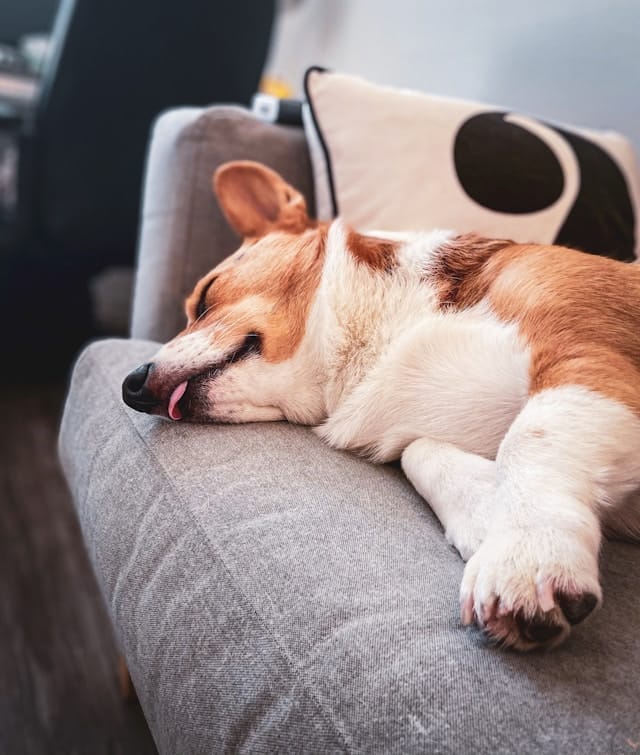
#2 - Safe Havens For Real Rest
Some dogs actually already have a decent daily routine but still struggle to get enough sleep because they don’t have a place where they can fully shut off.
A safe haven is a space away from:
noise
movement
interruptions
other animals or children
constant activity
Many dogs nap in living rooms or on sofas, but that doesn’t always mean they’re resting deeply. Every time an owner stands up, moves, or does something, those dogs often wake up or become unsettled even if it doesn’t look obvious.
This is why safe havens work best when they’re:
in quieter areas of the home
away from main walkways
predictable and undisturbed
For some dogs, this may mean a separate room. For others, a tucked-away space with minimal traffic can work too.
When dogs know they won’t be disturbed, their system can fully relax, and real recovery can become possible.
#3 - A Consistent Wind-Down Routine
Sleep doesn’t happen instantly, and it doesn’t happen by accident.
A wind-down routine helps your dog transition from activity into rest. It brings them from a high level of arousal down to a place where sleep is actually possible.
Think of it like how we (humans) unwind after work...you don't go straight to bed after work, you eat, watch TV, maybe have a bath — there’s a transition.
Effective wind-down routines:
happen after activity
don’t add more stimulation
help the body and brain slow down
They don’t need to be complicated. What matters is that they consistently signal: activity is finished, it's time to sleep.
Is your dog struggling to sleep or properly switch off?
If your dog finds it hard to settle, has broken or restless sleep, or never seems to fully recover, the issue often isn’t stimulation — it’s a lack of restorative rest.
The Dog Owner’s Guide to Restorative Rest gives you a clear, step-by-step Protocol to improve your dog’s sleep and support regulation.
The Sleep Protocol is completely free and available inside the Regulators Resource Vault.

Final Thoughts
When all these pieces come together — consistent routines, proper wind-downs, and a safe place to rest — sleep stops being a battle our dogs are constantly fighting.
When dogs are actually able to rest, settle, and recover, everything else becomes easier:
behaviour stabilises
stress reduces
regulation improves
training becomes more effective
Sleep supports the entire system!
A FREE community with downloadable guides and resources, and people who get it.
A simple and structured reset for overstimulated, dysregulated, chaotic dogs.
Simple, clear guidance to help you understand your dog through a regulation-first lens.


